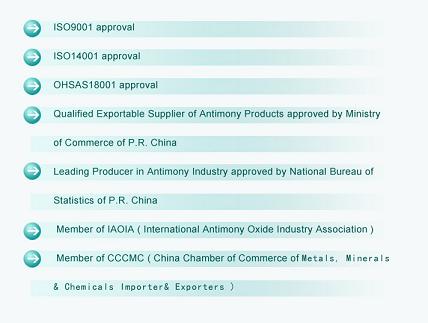
As manufacturer specialized in manufacturing of Antimony trioxide and Non-Halogen Flame Retardant,Since 2000, JIEFU have pioneered the manufacturing of flame retardant masterbatches in China.JIEFU initiated from custom flame retardant compounding of all commodity and engineering plastics to technologically sound production of fiame retardant masterbatches under the brand name JIEFU masterbatches.

Friday, June 20, 2008

Manganese production decreases

20 Jun 08 - As the market turns dull and the production costs remain high, manganese production has been falling. Sources reported to Asian Metal that the market will be even more stagnant and many smelters are about to halt for maintenance.
Asianmetal(English) http://www.asianmetal.com 1XOB
A Guangxi-based smelter complained the transportation of manganese ore has been blocked by the flood. "However, we are not worried about the production as the market is so quiet that we can hardly conclude any deals," said the source who just maintains one of the two production lines to fulfill the signed contracts and is about to halt after finishing the previous orders.
Asianmetal(English) http://www.asianmetal.com 4PRQ
The source claimed many smelters keep some stocks at hand and they might not release the materials unless the major stainless steel mills start purchasing. "While the stainless steel market also keeps dull in China and the foreign buyers are out of the market, we see no hope for the manganese market to warm up in the coming months."
Asianmetal(English) http://www.asianmetal.com I00M
Another Hunan-based smelter who just closed their production due to the low market, confirmed to Asian Metal that as more materials are stocked in the market, the suppliers are very pessimistic about future business. "Some suppliers are underselling their stocks and they just keep a minimum output," said the source who is about to halt for maintenance.
Asianmetal(English) http://www.asianmetal.com 2K4I
The source claimed export market is also very quiet and suppliers see no hope. "More and more smelters would cut down production just as what the stainless steel mills have done."

...
Read more...

Magnesium price may drop further in Russia

Magnesium price may drop further in Russia with the decline of magnesium market in China. Participants reported to Asian Metal that the concluded price of magnesium ingot was around RUB170-175/kg (USD7,190-7,400/t) and suppliers have difficulty selling the material at RUB180/kg (USD7,612/t) for the time being.
A Russian consumer purchased 10t of magnesium ingot at a lower price yesterday with the monthly purchasing volume of around 20-30t of magnesium ingot in the spot market. "The magnesium market is in a state of chaos as we received offers from RUB165/kg (USD6,978/t) to RUB190/kg (USD8,035/t), while few deals are concluded in the market," said the source.
The source said that some traders were active in purchasing early June as they believe the price may go up further. However, consumers are reluctant to purchase, which leads to large stocks in the market. "We think the mainstream price is around RUB170-173/kg (USD7,190-7,316/t). We are unwilling to purchase at RUB180/kg (USD7,612/t) currently," said the source.The source believes the magnesium price may go down in a short time due to adequate supply.
A Russian trader said that few deals are concluded as some consumers stop purchasing to wait for lower prices, unwilling to accept the price of RUB180/kg (USD7,612/t). "We still offer RUB180/kg (USD7,612/t) for magnesium ingot, the same as that of last week. Yet we have not concluded any deals this week," said the source.
Asianmetal(English) http://www.asianmetal.com YMUH
In view of the current market situation, the source plans to lower offers soon.

...
Read more...

Magnesium in Europe nudges down

Sliding price of magnesium in Chinese market is affecting price in Europe as sources reported deals concluded at around USD5,800-5,900/t in warehouse Rotterdam because materials bought at high price are still in Europe. According to participants, the dropping price in China could only reflect much in European market when new material arrives in Europe.

Meanwhile, market is extremely quiet with buyers buying only hand to mouth and waiting for the price drop in Chinese market to touch the floor.

Some participants reported getting offers from China as low as around USD5,040/t while most market participants reported quotations at around USD5,400-5,600/t. However, the general feeling in the market is that price will continue to move down until some producers start to close down for Olympics then sellers will have a good reason to ask for high prices.

According to an European dealer who put the price in warehouse Rotterdam at around USD5,800/t, although he has not concluded any deals recently due to weak demand, market is resting and will start to move again if Chinese suppliers reduce their stocks.

Another trader reported some inquiries recently which he will quote at around USD5,800-5,900/t in warehouse Rotterdam as spot deals are at that price, down from around USD6,000-6,100/t they were selling before.

The source agreed that price in Europe will go down gradually because material bought from China now has not arrived in Europe. The source added that there is less material in Europe at the moment since buyers are not buying because of the high price and if anybody wants to buy material now, he should pay what suppliers quote.

But the fact is that buyers are watching the market as price in China is going down and most of them expect it to hit below USD5,000/t FOB.

...
Read more...

Magnesium producers expecting higher prices

After the magnesium ingot market stopped falling Tuesday, producers expect higher prices in the following week. Some of them have started to raise offers to test the market, sources reported to Asian Metal.
A Shanxi-based producer is fully running at its capacity of 5,000tpy with around 40t of magnesium ingot in stock. "We lifted our offer to RMB32,500/t ex works today from RMB31,500/t (USD4,578/t) ex works late last week, but no deal has been concluded at the increased price," said the source. "Consumers need time to accept the price rebound."
The source confirmed that the price dropped drastically last week when some small smelters undersold materials at around RMB30,000/t ex works or lower prices. "In fact, we also sold small quantities of magnesium ingot at around RMB30,500-31,000/t (USD4,433-4,506/t) ex works," said the source. However, after the price plummeted from a level above RMB36,000/t (USD5,233/t) ex works to around RMB31,000-32,000/t (USD4,506-4,651/t) ex works late last week, most smelters would not like to lower prices further.
Asianmetal(English) http://www.asianmetal.com 6BSY
The source revealed that they have received more inquiries since Wednesday, mirroring that the market demand is warming up. Therefore, the source predicts that the market will rise slightly in the following week.
Another Shanxi-based producer reported that the market trend is still unclear. "To be exact, the market stopped decreasing rather than rebounded," said the source. The source confirmed that some smelters have begun increasing offers since Wednesday, but the market still sees few deals concluded as consumers refuse to accept the increased prices. Meanwhile, the export market remains sluggish, which will not encourage the domestic price increase.
Nevertheless, the source thinks that the price is likely to keep stable or rise slightly in the near future given the fact that small smelters who have sold most of their stocks in the past two weeks will not have many materials to be released in the spot market, and large smelters are still insisting on high prices above RMB33,000/t (USD4,797/t) ex works. Furthermore, some smelters which do not comply with the environmental standard will be shut down soon before the Olympic Games.
The smelter is running at its capacity of 1,500tpm and most of the products are exported. It is still fulfilling contracts signed at USD5,800-6,100/t FOB without any new deals concluded recently. According to the source, many exporters put their offers at USD5,400-5,500/t FOB, though the export market keeps quiet.

...
Read more...

Friday, June 6, 2008

Global polymer providers announced product prices increase

Various raw material providers in the polymer business have announced their decisions to increase product prices starting from this June or July.

As of June 1 this year, BASF will raise its gross market price (GMP) for Polystyrene by 100 euros per metric ton. BASF claimed that the prices of styrene had reached a historical high in the past week, saying a further price increase may be possible.

To response to the surge of energy cost, Dow Chemical also announced last week the rise of all its products by up to 20% – depending on their exposure to rising energy, feedstock and transportation costs – and will review all terms to all customers.

Rhodia Polyamide and Solutia, two global nylon providers, have also announced that they will increase the prices of some of their polyamide products starting from July 1.

Rhodia Polyamide decided to increase the price of its PA 6.6 Stabamid Polymer range in Europe by 200 euros/MT, effective from July 1 – or as contracts allow – in order to offset rising raw material, transport and energy costs.

Solutia, as announced on June 4, also increased prices by 10% across its Ascend and Vydyne (PA66) resins worldwide. The increase applies to orders shipped on or after July 1 and will be applied across the Ascend and Vydyne product families.

...
Read more...

Tuesday, June 3, 2008

Magnesium price moves down in China

Magnesium ingot market slowed down late last week when more traders and consumers stood on sidelines without purchasing. Participants anticipate lower prices of magnesium ingot in the first half of June.

A Shanxi-based smelter, running with an output of 400tpm, reported that the magnesium market became stagnant late last week when consumers refused to accept high offers of RMB36,800-37,000/t (USD5,295-5,324/t) ex works and smelters would not like to lower offers.

"We sold small quantities of magnesium ingot at prices slightly above RMB36,500/t (USD5,252/t) ex works early last week, but failed to conclude deals at higher prices later," said the source. "Except that end users still purchased from hand to month to maintain production, most traders ceased buying due to the dull export market."

The source reported that some smelters in the region have lowered offers to RMB36,300-36,500/t (USD5,223-5,252/t) ex works to attract buyers. "But we won't reduce our quotations sharply as most of our output before June 8 has been ordered," stated the source. However, the source is not so optimistic about the market in June, fearing that the whole market may be dragged down fast by some small smelters who would cut down offers to promote sales in order to collect money quickly to pay the increasing prices of raw materials.

"We have started to receive unsolicited offers of magnesium ingot since Thursday, mirroring the market slowdown," a trader source reported to Asian Metal last Friday. "However, we'd prefer to hold back from buying at the quoted prices of RMB36,400-36,500/t (USD5,237-5,252/t) ex works as we firmly believe that the market may go down sharply."

...
Read more...

Sunday, June 1, 2008

Brominated Flame Retardants

1. Introduction to Brominated Flame Retardants

1.1 Flame retardants
1.2 The Chemistry of Brominated Flame Retardants
1.2.1 Polybrominated Diphenyl Ethers
1.2.2 Polybrominated Bipenyls
1.2.3 Tetrabromobisphenol A and Derivatives
1.2.4 Hexabromocyclododecane
1.2.5 Other Brominated Flame Retardants
1.3 European and Global Consumption of Flame Retardants
1.4 Emission from Products in Service

1.1 Flame retardants

Flame retardants are added to polymeric materials, both natural and synthetic, to enhance the flame-retardancy properties of the polymers.

There are four main families of flame-retardant chemicals:

Inorganic flame retardants including aluminium trioxide, magnesium hydroxide, ammonium polyphosphate and red phosphorus. This group represents about 50% by volume of the global flame retardant production /9/.
Halogenated flame retardants, primarily based on chlorine and bromine. The brominated flame retardants are included in this group. This group represents about 25% by volume of the global production /9/.
Organophosphorus flame retardants are primarily phosphate esters and represent about 20% by volume of the global production /9/. Organophosphorus flame retardants may contain bromine or chloride.
Nitrogen-based organic flame retardants are used for a limited number of polymers.

Global production figures and trends in consumption are discussed further in section 1.3.

About 350 different substances used as flame retardants are described in the literature. The index of Flame Retardant /13/, an international guide to more than 1000 products by trade name, chemical, application, and manufacturer, contains more than 200 chemicals used in commercial flame retardants. A comprehensive list of flame retardants is compiled by the Swedish National Chemical Inspectorate /14/.

Read more.....

...
Read more...

************Honor*************

************Honor*************