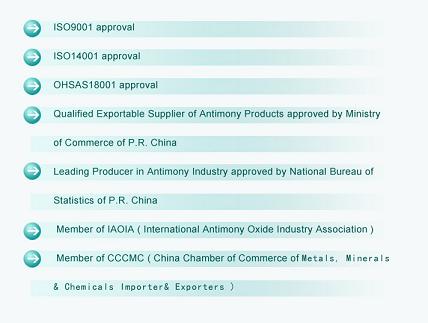
As manufacturer specialized in manufacturing of Antimony trioxide and Non-Halogen Flame Retardant,Since 2000, JIEFU have pioneered the manufacturing of flame retardant masterbatches in China.JIEFU initiated from custom flame retardant compounding of all commodity and engineering plastics to technologically sound production of fiame retardant masterbatches under the brand name JIEFU masterbatches.

Monday, October 20, 2008

Chinese molybdenum market summary Oct 13-17

With demand remaining weak in Chinese ferromolybdenum market, participants stop lowering offers sharply this week, and the market appears generally stable. Offers for ferromolybdenum slip slightly to RMB200,000-205,000/t (USD48.88-50.1/kg), down by about RMB5,000/t (USD1.22/kg) compared with that the previous weekend, while offers for molybdenum concentrate slide to around RMB2,700/mtu (USD17.96/lb). However, low prices are seen in the market, though major suppliers claim that they offer high prices. Some deals for ferromolybdenum are reportedly concluded at around RMB190,000/t (USD46.43/kg), and a major consumer purchased ferromolybdenum at below RMB190,000/t (USD46.43/kg) in the weekend.
Seeing the slow steel market, Chinese ferromolybdenum market has little chance to recover in the near future. Meanwhile, because the price of molybdenum concentrate is getting close to the mining cost, participants believe that the price decrease would be limited in the future.
Meanwhile, the export market generally stalls. As European molybdenum market dropped by over USD5/kg for ferromolybdenum, few people are interested in purchasing. Traders are under the pressure of credit obligation, dumping inventories for cash. Few buyers dare to purchase materials for prompt shipment, while few deals of molybdenum oxide 57% were concluded at USD28-29/lb. Insiders believe the price of ferromolybdenum would fall to USD60/kg or below with firm enquiries.
Molybdate market keeps slipping. Prices for grade-one ammonium tetramolybdate decreased to around RMB200,000/t (USD29.33/kg), while some deals were reportedly concluded at a little bit higher than RMB190,000/t (USD27.86/kg). The market is so slow that many smelters have halted production
Molybdenum products market is chaotic with all kinds of offers appearing in the market. Participants lament about the falling prices in both domestic and overseas markets, and the price of wrought molybdenum bar is getting close to USD60/kg.

...
Read more...

Sunday, October 19, 2008

Shaw River expands manganese metal footprint

West Perth-based Shaw River Resources Ltd has picked up a majority interest in eight tenements that neighbour its Mt Minnie project in the Ashburton region of Western Australia.

In an announcement today, Shaw said it will acquire an 85 per cent interest in the tenements from Contact Uranium Ltd for the consideration of 2 million Shaw shares and 1 million, 20c five-year options.

Under the deal, Contact will retain a 15 per cent free carried interest in the tenements until a decision to mine, at which point it can elect to contribute to the project's development or sell the rights to Shaw.

"These acquisitions extend our Mt Minnie tenement holding by 370km2 to 2500km2," Shaw managing director Vincent Algar said.

"We consider the entire area as having excellent prospectivity for large scale mineral deposits. We will focus on manganese, iron ore and base metal exploration on the tenements.

"The acquisition complements our existing portfolio and builds upon Shaw
River's Manganese strategy." – WA Business News

...
Read more...

China still hungry for zinc?

China remained a net importer of refined zinc in August, while imports of zinc concentrates also continued to run at a robust pace. Both phenomena are underpinned by the London-Shanghai arbitrage, which has been import-friendly since just about the start of the year.

However, the continued flow of metal and concentrates into China may be a harbinger of future problems for both the domestic and international zinc markets.

REFINED ZINC Imports of refined zinc (not including zinc alloy) were 25,590 tonnes in August, compared with just 5,900 tonnes in August 2007. Cumulative imports of refined zinc surged by 36.9 percent to 125,499 tonnes in the first eight months of this year. With exports simultaneously plummeting by 78.4 percent to 50,952 tonnes over the same timeframe, China has flipped rom

heavy net exporter to net importer for the first time since mid-2006. Net imports so far this year have totalled 74,547 tonnes, with 46,880 tonnes of that occurring in the two most recent reported months, July and August.

But does China really need this metal to fill a domestic production-consumption shortfall? The answer seems to be no. Visible stocks in the form of inventory held by the Shanghai Futures Exchange (SHFE) are high and largely static at 71,214 tonnes as of last Friday's warehouse report. Off-market stocks are said to be even higher and also largely static. Prices in China have fallen by over 25 percent this year and are currently stuck either side of the 14,000 yuan per tonne

level. Indeed, the domestic market has been so weak that a grouping of small producers announced in July a collective production cutback in an effort to support prices. Such conditions hardly seem supportive of rising net imports, but this is exactly what is happening. The driver appears to be not physical metal shortage in China but the fact that SHFE prices have still not fallen as far as LME prices. This has kept the arbitrage open for imports since the start of this year, creating a dollar-denominated financing

opportunity for merchants seeking to circumvent tight yuan-denominated lending conditions within China.

CONCENTRATES

While imports of refined zinc are rising, so too are imports of zinc concentrate. At 195,838 tonnes August imports of concentrates were down by 6.1 percent year-on-year but the underlying trend remains upwards.

Cumulative imports of the raw material rose by 11.9 percent year-on-year to 1.42 million tonnes in the first eight months of 2008. (Note, by the way, that these figures are for bulk-weight concentrate, not metal contained.) This uptrend is being extended from an already high base. Imports of concentrate rocketed by 159.7 percent in 2007 as Chinese smelters feasted on global market surplus after a period of highly constrained mine production growth. At first sight rising raw material imports also look incongruous at a time of smelter cutbacks and market weakness. China's annualised production of refined zinc peaked at 4.5 million tonnes in June, since when it has fallen back sharply to 3.9 million tonnes in both July and August. The country's mined zinc production has been experiencing accelerating growth this year with cumulative output up by 17.6 percent in the first eight months of 2008.

Why then does China need growing amounts of concentrate? The answer seems to be to feed an imminent refined metal production growth spurt. The country's top zinc producers declined to join their smaller counterparts in cutting back production and several are now bringing on stream major expansion projects. In August alone three producers, Zhuzhou, Yuguang Gold and Dongling Group, activated a combined 280,000 tonnes per year of new capacity. These facilities will ramp up steadily over the end of this year.

BEARISH AND BULLISH

This new capacity is only going to add to the existing oversupply in the country, which is already being exacerbated by rising metal imports. This has bearish implications for domestic prices in the short term. It also has bearish implications for the international market because if domestic market surplus keeps building, there will be increasing pressure for it to burst the dam walls and flood into the international market-place. This has happened before, between November 2006 and March 2007, when 280,000 tonnes of refined zinc were exported. All it takes is a switch in the London-Shanghai arbitrage in favour of zinc exports. Over a longer-term horizon, though, this curious Chinese dynamic may turn out to be bullish. The country's producers are bringing on new smelter capacity just as the international concentrates market is re-tightening. The list of mine closures and cutbacks in response to low prices is lengthening all the time and the consensus is that more will come.

Chinese treatment and refining charges are already starting to slide in response and concentrates availability may become a major constraint on Chinese smelters from next year onwards. Depending on the evolution of the current Chinese zinc dynamics, it is just possible that the country is going to need that refined metal surplus after allif it hasn't already left, of course.

...
Read more...

Global lead mkt seen close to balance in '09

Global refined lead production and consumption will be closely matched in 2009, leaving the market with only a 10,000 tonnes surplus, the International Lead and Zinc Study Group (ILZSG) said.

Global refined lead output will rise by 3.8 percent to 9.0 million tonnes next year, while consumption will increase by 4.0 percent to 8.99 million tonnes, the Lisbon-based group said in a press release on Monday after a two-day meeting late last week.

This year the organisation predicts a 31,000 tonnes surplus, based on output of 8.697 million tonnes and consumption of 8.666 million.

In April the ILZSG said it expected the lead market to record a 26,000 tonnes surplus this year.

The ILZSG said a forecast 2.1 percent drop in demand in Europe this year would push usage there to its lowest level since 1994. A further 1.4 percent drop was predicted in 2009.

Global demand growth would be driven mainly by a forecast 19.1 percent rise in offtake in China this year and by a further 9.5 percent increase next year.

Refined lead output growth would be underpinned by several countries, including Canada, China, the United States and the United Kingdom.

Global lead mine output would rise by 2.2 percent in 2009 to 3.97 million tonnes after a predicted 7.5 percent increase to 3.88 million this year.

Rising mine production in Bolivia, China and the Russian Federation next year would be partially offset by losses in Australia and Poland, the ILZSG said.

Wednesday, October 15, 2008

...
Read more...

Chinese electrolytic manganese market continues to decline

It is reported that domestic electrolytic manganese market has continued to decline, with markets in different areas dipping. Currently in Hunan, the offer of CNY 19000 per tonne can hardly sustain itself. In Chongqing, it stays at CNY 19000 per tonne to CNY 19100 per tonne and in Ningbo, the market even found offer of CN Y 19000 per tonne. Trade remains rather thin as a whole.

Some enterprises in Hunan said, demand for electrolytic manganese was too weak, and some enterprises had suspended production for maintenance. Domestic demand is not likely to rebound in short term. Besides, foreign trade of electrolytic manganese remains unsatisfactory too, and the price in the international market has dropped along with the downtrend.

Given the impact brought about by European and American economy, most market insiders are now worrying about the further price drop. If so, more mills would opt for halting production. – Steel Guru

...
Read more...

Brazilian manganese ore export in August up by 154% MoM

It is reported that Brazil has exported 329,294 tonnes of manganese ores in August 2008 up by 154% MoM as compared with 129,615 tonnes in July 2008. The exports in August recorded the largest one per month in the past years and accelerated to increase exports of manganese ores from Brazil because of the steeply risen prices of manganese ores and manganese ferroalloys in the world.

In August of 2008, Brazil exported 1,675 tonnes of medium and high grade manganese ores and 327,619 tonnes of other manganese ores. Also, another characteristic in exports of manganese ores from Brazil in August was that 1,675 tonnes of high grade manganese ore were exported from Brazil to mainly China.

According to the customs-statistics released in Brazil, the export of high grade manganese ore from Brazil continued to be nil from March 2007 but Brazil resumed to export high grade manganese ore from April 2008. However, the exports of Brazilian high grade manganese ore were shipped to only two countries of Turkey and China, having had a very small share of 0.5% of the whole. The reality, which Brazil exported many cargoes of high grade manganese ore under name of low grade manganese ore, has still continued.

The total quantity of manganese ores exported from Brazil in January to August 2008 period came to 1,512,000 tonnes, up by 76.6% YoY as compared with 701,780 tonnes in the same period of 2007 and included 450,000 tonnes for China and 470,000 tonnes for France. Therefore, the exports of manganese ores from Brazil to China and France in the first 8 months of 2008 shared a majority of the whole.

For a reference, the quantities of manganese ferroalloys exported from Brazil in August of 2008 were 3,392 tonnes of high carbon ferromanganese, up by 94.8% MoM, 702 tonnes of medium and low carbon ferromanganese, down by 48.4% MoM and 5,798 tonnes of silicomanganese, down by 19.9% MoM. – Steel Guru

...
Read more...

Wednesday, October 15, 2008

High prices slow down rubber trade

September 15, 2008: Prices of natural rubber in the spot market stayed strong, slowing down trade activities to a great extent.

The RSS4 grade closed at Rs 141 per kg on September 10. Natural rubber prices scaled up by as much as 37 percent since April, reaching record levels of Rs 142 per kg in the last week of August.

The dull phase is also being attributed to the onset of the holidays, with the Onam festival just round the corner.

Tight market conditions are also a result of growers' reluctance to sell products just yet since they are anticipating a further increase in prices. In Kerala alone, close to 50,000 tons is lying with growers, which is yet to be processed.

Domestic tyre manufacturers are now focusing more and more on rubber imports for production, with domestic prices rising at an unwarranted rate. Most of these imports - currently priced at Rs 132 per kg - are likely to come in from Thailand.

It is a feasible proposition for tyre manufacturers since rubber constitutes almost 60 percent of the total cost of production. According to media reports, some 3,500 tons has already been contracted and would soon be arriving from Thailand. In addition to this, tyre manufacturers hold a license to import more than 10,000 tons of rubber.

Such a situation has arisen despite the fact that India's production grew almost 28.1 percent in the first five months of the current financial year. While production during these five months reached 3,12,565 tons, consumption rose 6.8 percent and touched the 3,71,460 tons mark.

Prevailing market conditions encouraged producers to tap more. Production of this additional volume, as is evident, has not helped soften prices. Instead, movement has only been upwards. This is because all that was tapped has not managed to find its way into the market.

The end of the festive season is likely to bring about some correction in prices. However, it might not be to a great extent because a large number of buyers who require the commodity and are not buying because of high prices, would then crowd the market, creating a supply crunch. Growers once again would show some reluctance.

However, the silver lining is that rubber is an agro product and has a limited shelf life. Therefore, the stand taken by tyre manufacturers should, in all probability, result in slightly relaxed prices.

...
Read more...

************Honor*************

************Honor*************