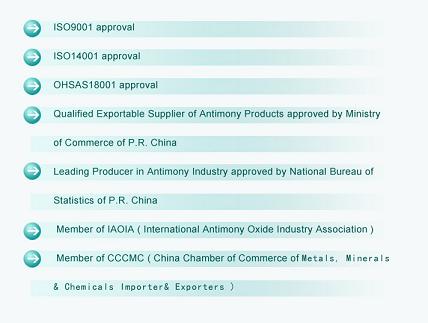
As manufacturer specialized in manufacturing of Antimony trioxide and Non-Halogen Flame Retardant,Since 2000, JIEFU have pioneered the manufacturing of flame retardant masterbatches in China.JIEFU initiated from custom flame retardant compounding of all commodity and engineering plastics to technologically sound production of fiame retardant masterbatches under the brand name JIEFU masterbatches.

Sunday, May 10, 2009

Total output of ferro-alloys by China in Q1 / 09 had decrease of 7%

Zone To Produce Silicon Alloys Had Considerable Decline In Its Output, Causing Tight Supply

The production activities of ferro-alloys in China for the first quarter (January – March) of 2009 were known. Namely, China produced 3,928,900 tons in total of ferro-alloys in January – March quarter of 2009, having decreased by 7.10% compared with that (4,227,900 tons) in the same quarter of 2008. For a reference, China produced 1,574,200 tons in total of ferro-alloys only in March of 2009, which had a decrease of 6.8% compared to that (1,689,000 tons) in the same month of 2008.

According to the data compiled and released by WSA (World Steel Association), China produced 127.44 million tons of crude steel in January – March quarter of 2009, having increased by 1.4% compared with that in the same quarter of 2008, and also produced 45.10 million tons of crude steel only in March of 2009, which had a slight decrease of 0.3% from that in the same month of 2008.

In comparison with a slight increase of crude steel production in China for January – March quarter of 2009, the total output of ferro-alloys in China for the quarter decreased to a considerable extent. This decline in production of Chinese ferro-alloys was due to a sluggish tone on exports of ferro-alloys from China and a sharp fall of prices for ferro-alloys caused by the depressed market. However, when the production activities of ferro-alloys at each district of China in the first quarter of 2009 were investigated in detail, the quantities of ferro-alloys produced in the so-called silicon land, consisting of Inner Mongolia Aut Region, Ningxia Hui Aut. Region and Gansu Province, had large decreases of 22 – 57% from those in the same quarter of 2008. These decreases in production of ferro-alloys had been caused by a severe winter climate but, as the silicon land faced the same severity in winter season of last year, the circumstances in both of 2008 and 2009 are thought to be on a similar level. Only the reason, why the production of ferro-silicon in China for the first quarter of 2009 had a substantial decrease, is supposed to be a negative intention to produce ferro-silicon as its price has fallen steeply. However, in August – September of this year when the stocks of ferro-silicon in Far Eastern region, including Japan, are anticipated to be reduced to reasonable levels, it is worried that price of Chinese ferro-silicon may have a sharp rise on the background of the tight supply.

On the other hand, although it was once informed that the production of manganese ferro-alloys in China is anticipated to have a large decrease, main districts in China contrarily increased the production. In view of the fact that China also produces manganese ores at local mines, main areas to produce manganese ferro-alloys in China have been symbolized by the four districts of Sichuan Province, Guizhou Province, Guangxi Zhuang Aut. Region and Hunan Province. In January – March quarter of 2009, Guangxi Zhuang Aut. Region had a slight decrease of 5.8% in production of manganese ferro-alloys but other three districts increased their production by 41.6% in Sichuan Province, by 46.4% in Guizhou Province and by 33.1% in Hunan Province respectively compared to those in the same quarter of 2008.

The market prices of manganese ferro-alloys had once reached a peak in August of 2008 but, after that, have turned to fall. Price of Chinese silico-manganese has currently come down to a level of US$1,100 per metric ton CIF Japan, which is half of US$2,450 as prevailed previously. Price of high carbon ferro-manganese is US$1,300 per metric ton CIF Japan at present.

Needless to say, these prices are not payable for its production costs. Accordingly, it was once informed that these manganese areas as mentioned above have decreased their output of manganese ferro-alloys in the first quarter of 2009 to a large extent but, on the contrary, the data indicated certain increases in production of manganese ferro-alloys at these areas. The market prices of Chinese manganese ferro-alloys, such as silico-manganese, have suddenly fallen considerably from February – March of 2009 and one of the reasons for this sharp fall of prices is supposed to be due to an increase in production of manganese ferro-alloys. It goes without saying that other factors are a sharp fall of prices for manganese ores imported into China as raw material and a positive action on sales of silico-manganese at discounted prices taken by India.

As an aftereffect on excessive imports of manganese ores committed by China in 2008, a surplus of manganese ores stocked in China is estimated at 1 – 2 million tons and it is essential for China to digest these excessive stocks of manganese ores as soon as possible. Even under the present situation which the international prices of manganese ores are in the direction to fall further for the future, China has been urged to digest the stocked raw materials. The main areas to produce manganese ferro-alloys in China are those, having delayed to develop its economic circumstances, and many of these areas have positioned to produce ferro-alloys as a core business for local economy. Therefore, from a point of view to sustain local economy, it is difficult for these areas to reduce their production of ferro-alloys

...
Read more...

China puts ceiling on 2009 output of tungsten, antimony, rare earth

BEIJING, May 7 (Xinhua) -- China said Thursday it would impose a ceiling on the output of mineral resources like tungsten, antimony and rare earth in 2009 amid shrinking demand.

    The move is aimed to protect China's reserves of these minerals, the Ministry of Land and Resources said in an online statement.

    The country's tungsten ore concentrate output is limited to 68,555 tonnes this year; rare earth ore to 82,320 tonnes, and antimony ore to 90,180 tonnes, said the ministry.

    These quotas on output were based on decreasing demand across the world as a result of the ongoing global financial crisis, said the ministry.

    The ministry said it would also not take any license applications before June 30, 2010 for exploring the three resources.

    China holds 40.5 percent of the world's proven tungsten reserves, and is the world's biggest antimony producer. The nation has a proven rare earth reserve of 52 million tonnes, or about 58 percent of the world's total.

    The country started to cap the annual output of tungsten in 2002 and that of rare earth in 2006. It is the first time such restrictions have been placed on antimony.

    The ceiling on tungsten ore concentrates (with tungsten trioxide content above 65 percent) last year was 66,850 tonnes, and that on rare earth ore at 87,620 tonnes.

    The ministry said such caps are intended to stabilize global demand and supply of these products and ensure their sustainable use.

...
Read more...

Twinkling Star Brand Antimony Trioxide

We can supply Twinkling Star Brand Antimony Trioxide 99. 8%, 99. 5%, pls tell me which grade you need.
    For getting all the detailed information, you are invited to visit our web site,or Gmail for me:samjiefu@GMAIL.COM

Sb203  %        99.8     99.8      99.5       99         90

AS2O3 %       0.035     0.046     0.005    0.48       1.5

PbO %          0.01      0.065     0.09        0.2          4.0
Fe2O3 %        0.0015    0.0026    0.006    0.05        0.08

Se %           0.0004    0.0005    0.0007      0.05       0.07
White degree   97.7      97        95             93           90
Partcle length  0.5      0.65      0.70            1.2            1.5


    we are sure that we are able to meet your requirement,pls tell me which grade are need.
    For getting all the detailed information, you are invited to visit our web site, 

JIEFU antimony trioxide 

We can supply any quantity and any kind of Antimony products from stock.would you please inform us how many you need and your target price, then we will confirm ASAP. We are sincerely hope to do business with you and establish long term business relationship with your respectable company.

Look forward to hearing from you soon.

Sam Xu

Contact me:

MSN: xubiao_1996@hotmail.com

GMAIL: samjiefu@gmail.com

SKPYE:jiefu1996

...
Read more...

Magnesium Hydroxide

Capitalizing on our industrial expertise we fruitfully cater to our clients all across the globe with our exclusive range of Magnesium Hydroxide flame retardants that are formulated from best grades of chemicals. These are stringently tested on quality parameters testing for the accurate composition, effectiveness, pH value, purity etc.

Specifications
BR-2000BR-4000
Physical PropertiesMgO% >64.00%64.00%
Apparent Spec.gravity g/ml0.750.34
Hardness2.52.5
Dewatering temp °C340340
Thermal Wt. Loss % under 1000 degree 30.00%30.00%
Water content % (110°C) <0.50%0.50%
Whiteness%>94.00%97.00%
Particle size D100: <45um 5um
Um D 50: sedimentation method9um1.5um


Magnesium Hydroxide is Non-Halogenated, High thermal stable & non corrosive smoke suppressant and acid scavenger. Its high thermal stability - up to 340C enables its use where Aluminum trihydrate is not sufficiently stable.

Magnesium Hydroxide provides flame retardance through FIVE mechanisms:
  • Magnesium Hydroxide produces more char than ATH resulting in increased effectiveness and less smoke.
  • Magnesium Hydroxide dilutes the amount of fuel available to sustain combustion.
  • Magnesium Hydroxide during combustion, generates highly reflective magnesium oxide coating which deflects the flame's heat away from the polymer.
  • Magnesium Hydroxide contains 31 % bound water which is released beginning at 330" C and blankets the flame to limit oxygen available for combustion.
  • Magnesium Hydroxide absorbs 17% more heat from the combustion zone than ATH to reduce the prospect of continued burning.

...
Read more...

Hazards of Antimony Trioxide

Antimony trioxide is not considered a hazardous chemical by the Department of Transportation unless packaged in containers of more than 30 pounds. Typically, antimony trioxide is sold in bags of 50 pounds or 25 kilograms, neither of which meets this criterion. If the product is sold in super sacks, which can range from 1,000 pounds to 1,000 kilograms, then it must be shipped as a hazardous chemical of Hazard Class 6.1 and Packing Group III.

Proper personal protective equipment for handling antimony trioxide include goggles, gloves and a lab coat or work garment over street clothes. While antimony will generally not harm anyone who touches it with their bare skin, some people do seem to be more sensitive to antimony trioxide. In those cases, individuals develop a rash similar to poison ivy after prolonged or repeated exposure. This condition is known in the industry as antimony measles. People tend to be more susceptible to antimony measles when their skin is moist as when perspiring.

Antimony trioxide should not be ingested or inhaled if possible; so most manufacturing or packaging operations require their personnel to wear masks or respirators when dealing with antimony trioxide powder. If powder is inhaled, there is generally some mild irritation to the respiratory tract and the individual might experience a sore throat or cough. If for some reason antimony trioxide is ingested there can be irritation to the mouth, nose and throat as well as nausea, vomiting, bloody diarrhea, dizziness, and muscular pain. A doctor's care should be sought if ingestion occurs. Subjects with pre-existing conditions like heart disease or impaired respiratory function could experience more severe reactions more quickly so exposure should be limited.

Chronic exposure to antimony trioxide could result in heart or liver damage and according to the State of California, antimony trioxide is a carcinogen. Some companies that have employees who are exposed to antimony trioxide on a regular basis have each employee go through a yearly physical including chest x-rays to make sure there are no long-term adverse effects from their exposure. This is mostly precautionary, but is good practice.

It is also good practice for employees to wash their skin and hair thoroughly after exposure to antimony trioxide dust. As a result, many employers provide their employees with uniforms to wear while at work and then equip their locker rooms with showers so that everyone can clean himself or herself before they leave work. This way, you can ensure that no antimony trioxide leaves the facility.

SAM XU is a technologist with JIEFU. Amspec manufactures and distributes full package flame retardants.

...
Read more...

Sunday, May 3, 2009

Price of Chinese electrolytic manganese metal suddenly turns to rise

Following an expectation to recover stainless steel production in China and a rebound of prices for nickel and chrome as raw materials for stainless steel production, an attitude for sales of Chinese electrolytic manganese metal has suddenly turned to be aggressive. Both of producers and shippers in China have still held speculative factors as a Chinese characteristic and, being influenced by this aspect, the price of Chinese electrolytic manganese metal for export is now being offered at US$2,500 per metric ton CIF Japan.

The latest price of Chinese product for export prevailed in last week was US$2,300 per metric ton CIF. LME price of nickel metal as a rival for manganese metal has suddenly turned to rise from the 10th of April to a level of US$12,000 per ton from a lower level than US$10,000 per ton as seen before the 1st of April. Accordingly, price of nickel metal transacted in domestic market of China has been risen successively from the beginning of April, because Jinchuan Group, as a leading nickel smelter in China, has insisted on an improvement of the price at present, which is not payable for its production cost.

The sales of high carbon ferro-chrome at discounted prices by India have also disappeared from the market and spot price of charge chrome has risen by 14% to 65 – 66 US-Cents per lb. of Cr CIF Japan from the bottom (58 US-Cents) with keeping a basic tone to rise further.

The output of stainless steel by Baosteel Group of China in January – March quarter of 2009 is anticipated to maintain a scale of 100,000 tons without any increase of stocks and a future map of stainless steel production in China (viewed to decrease at the beginning of 2009 but is being felt to increase at present) is currently changing somewhat.

Being influenced by this change of the circumstances surrounding stainless steel, the market of electrolytic manganese metal in China has suddenly turned to take an aggressive attitude for sales. Since the Central Government of China has more strengthened the regulations for environmental pollution from the beginning of 2009, the production of electrolytic manganese metal in China has been driven to continue on a low level, in addition to a higher cost to be not payable for its production, and the supply situation of this metal in China has become tight. By taking a chance on a sharp rise of nickel prices, Chinese producers have endeavored to sell electrolytic manganese metal at high prices but this attempt is successful or short-lived, depending on further developments of the matter.

Even a forecast of nickel prices has divided. There is a view in the market that the production of stainless steel mainly in part of Europe and part of Asia (Taiwan and China) will revive in October – December quarter of 2009 and jump by 32% from that at present. On the other hand, at the Conference held in last week at Pittsburgh of the USA, an atmosphere was felt that the ceiling price of LME nickel will be on a level of US$13,000 per ton as the maximum for the time being. Therefore, a shortsighted view of nickel prices has divided to an extreme extent. – TEX Report

...
Read more...

Franklin quickly becoming significant antimony supplier

Franklin Mining, Inc. (PINKSHEETS: FMNJ) (FRANKFURT: FMJ) CEO William Petty confirms that since his public confirmation of the operating agreement at Bolivia's Turiri Mine, Franklin Mining has received numerous inquiries from both US and international manufacturers and distributors concerning product availability and is presently negotiating for laboratory testing and other evaluations prior to contracting for product delivery.

"The response to our Turiri announcement has been overwhelming. We have received inquiries wanting to purchase our production. And, we have been contacted by a couple of other antimony miners with question about distributing their product," said Mr. Petty.

"Bolivia has long been recognized as being one of the few countries with proven antimony reserves. Several small operators have expressed interest in working through Franklin to find buyers for their production."

About Franklin Mining, Inc: Franklin Mining, Inc. has mining interests in the United States and Bolivia. Additional information is available at www.FranklinMining.com.

...
Read more...

************Honor*************

************Honor*************