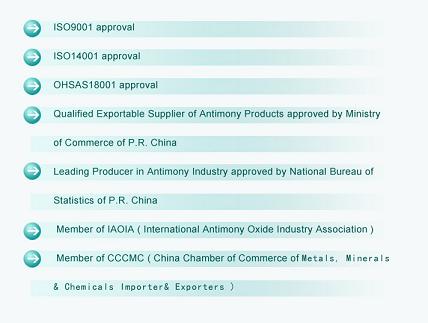
As manufacturer specialized in manufacturing of Antimony trioxide and Non-Halogen Flame Retardant,Since 2000, JIEFU have pioneered the manufacturing of flame retardant masterbatches in China.JIEFU initiated from custom flame retardant compounding of all commodity and engineering plastics to technologically sound production of fiame retardant masterbatches under the brand name JIEFU masterbatches.

Sunday, May 10, 2009

Chinese Zinc Futures Prices May Fall in The Short Term - Analysts

SHANGHAI, May 7 - Zinc futures prices on the Shanghai Futures  Exchange  (SHFE)  may slide in the short term on falling demand and increasing supply, an analyst said on May 6th.

"Zinc prices  have  rebounded  too  rapidly  recently  - the global zinc market expected  to  be in surplus this year. With the traditional slack consumption  season  from  May  to  August,  it is likely that SHFE zinc prices will  drop  in  the  near  future, Chen Xiaodong, an analyst from Guang Sheng Futures, said.

Chen added that the Chinese government has started implementing stricter controls  on  bank  loans  recently, which means there will be less cash flowing into commodity markets and commodity prices may be pulled down.

Furthermore,  increasing  market  supply  will have a negative impact on SHFE zinc  prices  in  the  near future. Since late March, domestic zinc output has  started  to  increase  due  to rebounding zinc prices, which encouraged  most  zinc  smelters  and  miners  to  restart operations at previously idle facilities, Sun Fan, an analyst from CITIC Futures, said.

Analyst Zhao Kai from Jinrui Futures predicted that domestic zinc pricesmay fall to RMB 11,000/mt (USD 1,612.15) before late August.

The most-traded  2009  August  zinc  contract  on  the SHFE ended at RMB 13,090/mt (USD 1,918.45) on May 6, up 1.36 percent from the previous trading day.

...
Read more...

Antimony trioxide price climbing higher everywhere

Following the increasing antimony metal price, price of antimony trioxide also increased in European market.
A European trader sold 10t of 99.5%min antimony trioxide to a local customer at USD3,900/t in warehouse Rotterdam in the end of last week, and he sees the price increased by USD100/t compared to the week before. The source claimed that his sales of the material is about 5-10t each week in April. "There is demand of antimony trioxide, but very little compared to last year," said the source.
He holds that there is no shortage of antimony trioxide in European market because there are several local producers, also all of them are not producing at the full capacity right now. However, since the Chinese suppliers increased the antimony quotations, European producers raised their offers too as they claimed higher raw material cost. Because the increasing price is not driven by increasing demand, the trader expects price to stabilize soon.
Another European trader confirmed the increasing price of antimony trioxide in Europe. "Chinese offers rose by USD200/t in the last two weeks from USD3,600-3,800/t to currently USD3,800-4,000/t CIF Rotterdam, and the material in Rotterdam warehouse increased from USD3,700-3,800/t to USD3,900-4,000/t in warehouse Rotterdam.
Agreed with the previous source, the trader thinks that the main reason of the higher price is due to the announcement from Chinese government that Hunan province was going to invest over one billion RMB on metal stock. "But the metals also including some base metals, antimony is going to be very small part of it," said the trader, and he thinks there is no momentum for price to increase further.

...
Read more...

Increased value-added tax rates on minerals kick in

A higher value-added tax (VAT) on 82 mineral products became effective Thursday.


China raised the VAT rate for minerals two months ago to ease the burdens of producers. Mineral producers welcomed the policy but analysts are uncertain whether the new tax rates would bolster the sector.


The VAT rate for such mineral imports as copper ore, nickel ore, aluminum ore as well as ore concentrates was raised to 17 percent from 13 percent, according

to the Ministry of Finance and the State Administration of Taxation.


The two ministries said the new rates will cover both ferrous and nonferrous metals and non-metal minerals. The rate for salt would remain unchanged at 13 percent.


"The four-percent increase is an adjustment of a big margin," a source inside the Henan Yuguang Gold and Lead Co. said. The man, who preferred to remain anonymous, added the company would be able to save a large amount of money it would have spent on taxes and will therefore be able to reduce costs.


Thanks to higher VAT rates, such companies will be able to deduct a larger amount of taxes paid for ore imports when they sell final products.


Jiang Ning, an analyst with the Shanghai-based nonferrous metals website, said it was too early to tell whether the nonferrous metal sector would perform better.


Nonferrous metal producers have posted all-round losses after prices fell by 20 to 46 percent in last few months. Some producers were forced to suspend production to avoid further losses.


According to the National Bureau of Statistics (NBS), profits of the non-ferrous metal and processing industry fell 34.1 percent year-on-year in the first 11 months of 2008.


Jiang said he expected the nonferrous sector to have a poor performance in the first quarter of this year.


In addition to higher VAT rates, the country's State Reserve Bureau, which maintains stockpiles of key raw materials, was reported to be discussing a purchase of 300,000 tonnes of aluminum at a premium price from producers. The move is aimed at increasing prices and supporting producers.


Jiang said if that happens, such a move would only be effective in the short term and was not enough to change the long-term trend. He added that the biggest problem for non-ferrous metal producers was insufficient demand after global financial turmoil slashed demand across the world.


The steel sector also suffered because of retreating global demand. The NBS said profits of the iron and steel industry fell by 13.7 percent during the first 11 months of 2008.


Many analysts said the metal industry in general is regaining confidence as a result of the proposed purchase plan. They said increased infrastructure construction would also boost demand for steel.


The VAT rate hike for mineral products was part of the country's more broad VAT reform which exempts companies from paying value-added tax for equipment purchases.


The reform was announced in November and included in the 4 trillion yuan (586 billion U.S. dollars) stimulus package.


The VAT reform is expected to reduce the tax burden on companies by more than 123 billion yuan next year.


In 2007, VAT revenue exceeded 1.5 trillion yuan, accounting for31 percent of the country's total tax income.

...
Read more...

Re: China puts ceiling on 2009 output of tungsten, antimony, rare earth

China's coal enterprises all appealed to the government for halting the resource tax reform considering the general gloomy economic situation and growing burden in coal production cost, according to market source.


Instead, coal enterprises asked for subsidy to value added tax to alleviate their production cost.


In a symposium held by Research Office of the State Council on March 18, coal enterprises claimed that the rise in cost pressure is the main reason for their reluctance to drop the coal price.


So far, domestic coal enterprises haven't conceded to China's five power giants on contractual coal price because of their high production cost.


Nevertheless, the ongoing research on resource tax reform plan has triggered coal producers' concern over further cost increase.


Meanwhile, coal enterprises are more likely to see a drop in coal price as some small coalmines resume production and the international coal price is in decline.


According to a coal enterprise source, many local coal enterprises especially those mainly producing power coal, are living a tough life and even incurred loss.


Earlier, market rumor went that the government would charge resource tax at 10 percent of sale revenue, much higher than the market guess at 3-5 percent.


Shi Yu, analyst with China Merchants Securities hold that China's coal industry has entered the recession period due to the great impact of international financial crisis on China's economy, and it is expected to take 3-5 years to walk out of the trough.

...
Read more...

China to raise export rebate for some nonferrous metals, report

Chinese government will adjust by a big range the import and export duties for some nonferrous metals in line with the draft of Adjustment and Development Plan for China's Nonferrous Industry, China Business News reported.


According to the draft, average export rebates for high-elegant copper tube, high-elegant copper plate and stripe, high-grade aluminum foil, high-grade aluminum formation products, high-grade aluminum plate and stripe will be raised from 5 percent to 13 percent.


Export rebate rate for deep-processed products, which can replace part of imported ones, will be raised to 17 percent.


Aluminum alloy formation products will receive an export rebate of 5 percent for the first time.


Export duty of aluminum alloy poles with section circumference of under 210mm will be cut from 15 percent to 5 percent.


The draft says domestic consumption of aluminum products won't shrink under the related bailout plans, but the growth rate may decrease.

...
Read more...

Export duties on ferroalloy may be lowered

China, the world's largest ferroalloy producer, is possibly to lower export duties on ferrochrome and ferromanganese in the second half of this year from current 20 percent to assist domestic producers in export businesses, a source with the China Ferroalloy Industry Association said.

Meanwhile, the government will soon release a name list of ferroalloy producers that are allowed to bargain with power companies on electricity fees on monthly basis.


China produced 18.25 million tons of ferroalloy last year, up 4 percent year-on-year, and is expected to produced 14 to 15 million tons this year.

...
Read more...

China's Yunnan In 2nd Round Of Metals Stockpiling For Reserves

China's Yunnan province launched its second round of metals stockpiling May 1, the provincial government's industry and communications committee said in a statement, in an effort to ensure steady growth for industries in the region.


The government buying includes purchases of copper, aluminum, lead, zinc and tin, as well as germanium, and industrial silicon, the statement said, referring to details in Yunnan's nonferrous metals stockpiling plan.

The move is similar to the province's first round of purchases of base metals in December, where it purchased a total of 552,000 metric tons of metals from nine producers.


The statement didn't specify the amount of metals the province plans to purchase this time but said other metal producers in addition to the nine in the first round are allowed to participate but will be under strict scrutiny in the application process.


The nine producers are Yunnan Aluminium Co., Yunnan Coal Chemical Industry Group, Yunnan Tin Co., Yunnan Luoping Zinc & Electricity Co., Yunnan Chihong Zinc & Germanium Co., Yunnan Jingding Zinc Co., Xiangyun Feilong Co., Yunnan Gejiu Electricity Plant, and Yunnan Copper Co..


Yunnan's second round of purchases will last eight months, from April 30 through Dec. 31, said the statement.

...
Read more...

************Honor*************

************Honor*************