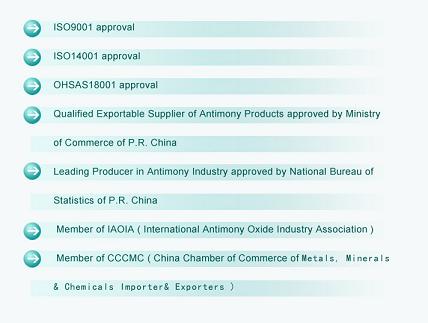
As manufacturer specialized in manufacturing of Antimony trioxide and Non-Halogen Flame Retardant,Since 2000, JIEFU have pioneered the manufacturing of flame retardant masterbatches in China.JIEFU initiated from custom flame retardant compounding of all commodity and engineering plastics to technologically sound production of fiame retardant masterbatches under the brand name JIEFU masterbatches.

Tuesday, January 22, 2008

Chinese manganese ore price high

Chinese manganese ore market remains at high price levels at present, and market participants believe the price of the material will not retreat in the near future.
A Shandong-based manganese ore trader, who offers Indonesian lumpy manganese ore 42% at RMB60/dmtu (USD8.25/dmtu) ex ports, has concluded no deal these days. However, the source thinks the price of the material is hard to retreat in the coming days, so he refuses to decrease the offer of the material now.
"Although manganese ore market is not very active now," said the source. "We will not decrease the offer of the material because I think our offer is lower than others, who offer the material at RMB65-70/dmtu (USD8.94-9.63/dmtu) ex ports in the spot market."
A Liaoning-based manganese alloy smelter purchased 80t of Brazilian lumpy manganese ore 46.7% at RMB90/dmtu (USD12.38/dmtu) delivered last week. The source thinks the price of the material lingers at high price level now.
"The price of the material is very high," laments the source. "And we have no choice but to purchase to maintain our normal production. However, we will not purchase the material in large quantities."
According to the source, they offer medium carbon ferromanganese 78%, C 1.5%max at RMB15,500/t (USD2,132/t) ex works now. The profit margin is too small due to the high cost of raw material.

...
Read more...

European manganese still in weak demand

In the last few days, it snowed in many areas in China. Manganese producers claimed that they were affected by the snow, for the raw material cannot be transported to them, and their products cannot be transported to the port. However, with weak demand and plenty of stock in warehouses, the price of manganese in Europe remains unchanged.

A German trader claimed that market is unchanged compared to last week while demand remains weak and prices stabilize at USD3,500-3,600/t in warehouse Rotterdam. Moreover, the Chinese producers are being more realistic and the offers from China are in the same range.

The source views European market is not a free market but rather dominant by a few large consumers who are currently holding enough stock for January to March production. "We need to wait until end of February or earlier March to see more demand in the market," said the trader who thinks price will remain stable before Chinese New Year.

Another European trader revealed that he received offers from Chinese suppliers in the range of USD3,500-3,800/t CIF Rotterdam, but he did not accept the offers as there is very little demand in the European market and he could buy material for Rotterdam prompt release at USD3,500-3,650/t.

The third trader agreed to the above traders and he thinks there are at least several thousand tonnes of manganese in the European warehouse so it is hard to push the manganese metal price up. However, he holds that more consumers will be interested in manganese flake in the near future as the MC and LC FeMn price continue to rise higher. Therefore, he prefers to wait for a while to see what will happen in the manganese market.

...
Read more...

Sunday, January 20, 2008

Nordic Mining acquires Finnish lithium project

Nordic Mining acquires 68% of Keliber Oy and confirms its strategy of
exploration and production of high-end minerals and metals. Keliber
has plans and permits for exploration and production of lithium
carbonate in Finland.

Keliber will be the first European producer of lithium carbonate,
scheduled to start production in 2010. One of the main applications
for lithium carbonate is for production of batteries to mobile phones,
laptops, electric vehicles, portable tools a.o. The increasing demand
for electric and hybrid cars is boosting production of lithium ion
batteries, indicating a positive forecast for lithium carbonate.

Keliber's production plant in Finland is expected to be cost
competetive with current production of lithium carbonate and has a
'green' profile with regard to both the process itself and the final
product.

'The realisation of the lithium project will give opportunities of
strategic and industrial importance for Nordic Mining', says Ivar S.
Fossum, CEO. Lithium is a mineral with advanced forward-looking
applications and is in particular attractive as a component in the new
generation of batteries. The shareholders of Keliber have build a
solid platform for further development in their preparations for the
first European production plant for lithium carbonate.'
Keliber's lithium project

Keliber Oy has mining concessions, permits and approved plans for
exploration of lithium minerals in Kaustinen in the Osterbotten region
in Finland.

In addition to mining concessions, the plans also includes a new
process plant for production of lithium carbonate. (Li2CO3).

Total investments are estimated to EUR 40 – 45 million. Keliber has
carried out project development for several years and the company is
ready to enter into contracts for civil work, construction and
erection once financing has been established. Nordic Mining will play
a key role in the financing of the project and will commence
preparations for this in the first half of 2008.

Production is scheduled to commence in 2010. Production will initially
be based on a resource of spodumene ore of approximately 3 million
tons with a grade of 0.92% lithium oxide. The spodumene ore also
contains economical grades of tantalumpentoxide and quartz-feldspar.
The planned production from this resource represent a sales value of
approximately USD 250 million at current market prices for lithium
carbonate. In addition, Keliber has exploration licences for two
spodumene deposits which at a later stage might be processed in the
same plant.
Increasing demand for lithium

Lithium has many industrial application areas and there are several
derivaties based on lithium, i.a. lithium carbonate. Lithium carbonate
is used for instance in the glass and ceramic industries, for
production of lubricants and in pharmaceutical products as well as in
various alloys. An important application area for lithium carbonate is
in batteries for mobile phones, computers, electric and hybrid cars,
electric tools etc.. Lithium has special properties as regards ability
to store electric energy, and the battery sector is an important
growth area for lithium carbonate.

Increased focus on environmental issues and CO2 emission have already
significantly affected the demand for electric and hybrid cars based
on lithium ion batteries. The large international car manufacturers
have development programs and focus which clearly indicate increased
relative importance of these car types in the coming years. Toyota, as
an example, has informed of plans to go 100% hybrid by 2020.

...
Read more...

Two ways to play the lithium boom

The natural resources boom has triggered investor interest in
little-known but important minerals such as lithium.

This soft, silver-white metal is used in the manufacture of
pharmaceuticals, lightweight alloys for aircraft, glass,
heat-resistant cookware, high-spec lubricants, airconditioners,
synthetic rubber and aluminium.

But its most exciting use is in rechargeable batteries. Lithium
products already power some 90 per cent of laptop computers and more
than 60 per cent of mobile phones, with big future potential in
battery-powered vehicles and power tools.

According to the US government's latest Minerals Yearbook: "Lithium's
natural properties make it the most attractive battery material."

The global market for lithium batteries has been increasing at annual
rates of more than 20 per cent over the past few years, and reached an
estimated value of $4 billion in 2005.

"Lithium batteries hold tremendous potential for continued growth,"
says the American study.

"Although some safety issues remain, new technologies are being
developed," and performance improvements have been significant, with a
doubling of energy density over the past 16 years.

Larger lithium batteries are being incorporated in new products. Last
year heavy-duty machine-tool manufacturers Milwaukee, Dewalt and Bosch
"introduced complete lines of tools designed around lithium-ion
batteries" that are "expected to eventually replace tools using nickel
cadmium batteries," as they deliver up to 50 per cent more power, with
longer running times and more charging cycles.

Major automobile manufacturers have announced plans to switch from
nickel cadmium to lithium-ion batteries for their future generations
of hybrid electric vehicles, and there is increasing prospect of their
use in plug-in pure-electric vehicles.

Such uses "could create tremendous increases in demand for lithium,"
says the US study.

Price data for lithium is not readily available as the metal is not
traded on public exchanges, but one industry source claims the price
of lithium carbonate – the most important internationally-traded
lithium compound by volume -- has doubled this year, to $5,500 a ton,
driven by strong demand for rechargeable batteries.

World production of lithium is only some 22,000 tons, the biggest
suppliers being Australia and Chile.

It's very difficult to invest in lithium. I have not been able to find
any pure plays. However, here are two stocks to consider.
Two stocks to gain access to lithium

The Chilean company SQM, listed in Santiago and in New York ADRs, has
the Canadian fertilizer giant Potash Corp. of Saskatchewan as its
godfather, with a 36 per cent interest.

SQM owns vast resources of lithium, nitrate, iodine and potassium
minerals in Chile's Atacama desert. It controls more than a third of
the internationally-traded market in lithium.

Trouble is, the company only gets 12 per cent of its sales from
lithium. It's predominantly a supplier of fertilizers and iodine.

Nevertheless, SQM seems to be a well-managed company that you might
want to have a piece of, despite that limited exposure to lithium. Its
sales topped $1 billion last year. Net income reached $141 million,
having grown at an average annual rate of 37 per cent over the past
four years.

Although the shares are currently trading on a price-earnings multiple
of 28x, with a twice-covered dividend yield of only 1.5 per cent, the
chart looks good, suggesting that investors are buying into the
company's fertilizer and lithium growth prospects.

Much more speculative is Admiralty Resources, listed in Australia.

It is developing two major projects in South America – Rincon Salar in
Argentina, estimated to contain 1.4 million tons of recoverable
lithium and 2.5 million of potash, and due to come into production in
a year's time, and Santa Barbara in Chile, an iron ore mine that's
about to start up.

AR is still running big losses, but investors obviously believe those
will evaporate, as an initial $200 million of annual revenues start to
flow in from the two projects.

The share price has quadrupled this year and the chart looks great.

If anyone knows of a better way to invest in lithium, let me know and
I'll pass it on to readers.

...
Read more...

Lithium supply may not be sufficient for electric car battery production, study finds

Key minerals used to create lithium batteries may not be sufficient to
meet future demand for plug-in hybrid and electric cars

The vast majority of world's supply of lithium carbonate, the mineral
used to make lithium-based batteries for cellphones and laptop
computers is found in just four countries: China, Chile, Argentina,
and Bolivia, reports William Tahil, director of research for Meridian
International Research in a newly released white paper entitled, The
Trouble with Lithium.

In an exclusive telephone interview with EV World (www.evworld.com),
Tahil contends that all of the world's current production of lithium
salts, which are extracted from brine lakes high in the Andes and
Tibet, is being utilized for small electronics and other industrial
applications, and while production capacity will double in the next
few years, the industry simply can't produce enough lithium to build
the hundreds of millions of large-format batteries needed to power the
electric cars and plug-in hybrids of the future.

Recently both General Motors and Ford Motor Company unveiled electric
concept cars at the North American International Auto Show that make
use of lithium-chemistry batteries. As recently as the 2007 State of
the Union address, George Bush has been promoting plug-in hybrids and
through an executive order is requiring federal fleets to buy them in
the future.

Tahil estimates as much of 15% of the world's known reserves of
lithium carbonate and lithium chloride would be required to equip each
of the world's 800 million cars and trucks with a relatively small, 8
kWh battery pack. GM's Volt concept car is powered by a 16 kWh lithium
battery pack. In his view, this is unsustainable. Instead, Tahil is
proposing that two other well-understood battery chemistries be more
actively investigated and developed: sodium nickel chloride and
zinc-air, both of which offer comparable or greater energy density
than lithium without the attendant safety or resource depletion
issues. After iron, aluminium and copper, zinc is the most commonly
used metal by modern society. A 2005 USGS estimate placed American
zinc reserves a 30,000,000 metric tons and world reserves, excluding
the US, at 220 million metric tons. Tahil estimates total world
lithium metal reserves at just 6,200,000 metric tons.

...
Read more...

Wednesday, January 16, 2008

Antimony trioxide

 Antimony trioxide is not a flame retardant  per se, but it is
used as a synergist. It is utilized in plastics, rubbers, textiles,
paper and paints, typically 2-10% by weight, with organochlorine and
organobromine compounds to diminish the flammability of a wide range
of plastics and textiles (IARC, 1989).

Antimony oxides and antimonates must be converted to volatile
species. This is usually accomplished by release of halogen acids at
fire temperatures. The halogen acids react with the antimony-
containing materials to form antimony trihalide and/or antimony halide
oxide. These materials act both in the substrate (condensed phase)
and in the flame to suppress flame propagation. In the condensed
phase, they promote char formation, which acts as a physical barrier
to flame and inhibits the volatilization of flammable materials. In
the flame, the antimony halides and halide oxides, generated in
sufficient volume, provide an inert gas blanket over the substrate,
thus excluding oxygen and preventing flame spread. These compounds
alter the chemical reactions occurring at fire temperatures in the
flame, thus reducing the ease with which oxygen can combine with the
volatile products. It is also suggested that antimony oxychloride or
trichloride reduces the rate at which the halogen leaves the flame
zone, thus increasing the probability of reaction with the reactive
species. Antimony trichloride probably evolves heavy vapours which
form a layer over the condensed phase, stop oxygen attack and thus
choke the flame. It is also assumed that the liquid and solid
antimony trichloride particles contained in the gas phase reduce the
energy content of the flames by wall or surface effects (Troitzsch,
1990).

Other antimony compounds include antimony pentoxide, available
primarily as a stable colloid or as a redispersible powder. It is
designed primarily for highly specialized applications, although
manufacturers suggest it has potential use in fibre and fabric
treatment.

Sodium antimonate (Na2OSb2 O5Ê´H2O) is recommended for
formulations in which deep tone colours are required or where antimony
trioxide may promote unwanted chemical reactions.

...
Read more...

Antimony oxide price spiral draws attention to alternatives-1994

Driven by an unbalanced supply-demand situation, prices of antimony oxide have climbed steeply this year with no end in sight. The result has been a scramble to reformulate where possible. Compounders that haven't actively considered alternative flame-retardant synergisms  since the last time antimony experienced unstable market conditions are reacquainting themselves with the likes of zinc borate and other zinc compounds, as well as compounds of Mo and Tin,

HIGH AND GOING HIGHER

Since late last year, prices of antimony metal have more than tripled while prices of the oxide have more than doubled. Through most of 1993, antimony oxide sold for $1/lb or a bit less. Prices now are about $3/lb and could go higher this month. Antimony oxide suppliers, consultants and other industry sources do not expect any relief soon.

But as in past instances (in the late- 1970s and mid-'80s) where antimony went through similar dramatic price/supply fluctuations, this situation will stabilize eventually. When that happens, one FR synergist supplier expects antimony oxide to hover around $2/lb. "I doubt we'll see the former lower levels," he says.

The main cause of the price increases is price setting by central planners in the People's Republic of China, the largest producer of antimony metal.

However, China and another producer, Bolivia, are suffering from depletion of reserves, while mine closings in places like Canada, Mexico, Bolivia, and Turkey have contributed to shortages in antimony metal. At the same time, demand is strong in the U.S.- up 10% so far this year - and in the Far East and developing countries.

Industry observers expect that old mines, particularly in Central and South America, will be reopened. But the time required to do so ranges from six months to a more likely 12-18 months.

SEARCH FOR ALTERNATIVES

Despite the runup in prices, no one expects to see large-scale replacement of antimony oxide in the near future. One industry source guesses that serious efforts at substitution won't come until and unless the oxide reaches $5.50/lb. For now, most of the reformulation activity is aimed at lowering the amount of antimony used - either by increasing the halogen content in the case of brominated FR additives or by partially replacing the synergist with another additive.

According to one supplier of brominated FR compounds, formulators have traditionally used bromine and antimony oxide at a 3:1 ratio, respectively. But with the rising cost of antimony oxide most are now going to a 4:1 ratio. "Three to one is believed to be the ideal ratio. An increase of the halogen fraction is likely to decrease the flame-retardant efficiency of the additive package but it does allow for cost containment," notes Dr. Marcelo Hirschler, a consultant on flame retardants based in Rocky River, Ohio.

According to consultant James Innes of Flame Retardants Associates, Naperville, Ill., the first major target for partial antimony replacement is PVC, as it is the most cost-sensitive application for the synergist. Other targets include polyolefins, PS, ABS, and engineering resins such as nylon and PBT. However, far less research has been done on synergism with bromine flame retardants than with PVC.

The consensus is that no alternative synergist is a true drop-in substitute for antimony oxide, making combination systems with antimony more likely. The more stringent the fire test that an end product must pass, the lower the likelihood that any alternative compound alone will suffice, notes Hirschler.

ZINC BORATE

"When people are looking to reformulate, we always start with zinc borate because it is still selling at less than half the price of antimony oxide. In flexible PVC, you can replace up to 50% of the antimony, depending on the applications," says Larry Musselman, technical director of the Polymer Additives Group of minerals supplier R.J. Marshall, Southfield, Mich. (The company supplies magnesium hydroxide, alumina trihydrate, molybdenum compounds, and a family of low-smoke inorganic complexes.)

Based on current market prices for zinc borate at $1.00-1.29/lb, partial replacement of antimony oxide with zinc borate can result in a cost reduction of 25-40% of the total synergist package.

Zinc borate can replace antimony oxide in whole or in part, depending on the resin and the flame-resistance specification, says Dr. Kelvin Shen, market development manager at leading zinc borate producer U.S. Borax, Inc., Valencia, Calif. "For example, in flexible PVC you want to use a high ratio of zinc borate to antimony oxide to achieve low smoke and good flammability performance."

To address the supply shortage and help users cut costs, Anzon Div. of Cookson Specialty Additives, Philadelphia, is working on synergistic systems of antimony oxide with zinc borate for flexible PVC applications such as wire and cable. Anzon, a long-time antimony oxide supplier, recently acquired the zinc borate business of Climax Metals Co., Englewood, Colo. (CIRCLE 26)

Beyond PVC, there is potential for replacing antimony with zinc borate in most halogenated systems, including polyolefins and styrenics, at typical use levels of 3-15 phr, says Shen. "In HIPS and ABS, you can replace up to 50% of the antimony and in PVC, nylon, or epoxy you can completely replace it with zinc borate."

Unlike antimony oxide, zinc borate also functions as a smoke and afterglow suppressant ,and in most systems, it works synergistically with antimony oxide. In other words, flame resitance may be improved by partial substitution of antimony with equal parts of zinc borate. HIPS and ABS are exceptions in that synergism has not been observed, but fire-test performance is not reduced with zinc borate/antimony combinations, Shen says.

Besides its standard Firebrake ZB grade, U.S. Borax has experimental Firebrake 415 and 500 grades, both with higher thermal stability (over 770 F) for use in engineering resins. (CIRCLE 30)

MOLYBDENUM COMPOUNDS

Molybdenum compounds are other synergists that can be used to partially or totally replace antimony oxide, says consultant Innes. Like zinc borate, molybdenum compounds function synergistically with halogen flame retardants and suppress smoke as well as flame. And as with zinc borate, most experience with molybdenum has been in PVC, particularly flexibles. Innes says it's "easy" to meet some less stringent flame specifications with molybdenum compounds; but in "applications where fire tests are very tough, such as plenum wire and cable jacketing, you cannot totally replace antimony."

Pure molybdenum compounds that can be used as flame and smoke suppressants are supplied by Climax Molybdenum Co., Pittsburgh, and R.J. Marshall's Polymer Additives Group. They typically cost $4-5/lb. (CIRCLE 43)

Pure molybdenum compounds from Climax Molybdenum include molybdenum trioxide, which sells for a bit under $4/lb, and ammonium octamolybdate, priced at $4-5/lb. Senior technical sales representative Bill Kennelly says these compounds can replace up to 50% of antimony oxide without a reduction in LOI (oxygen index). Kennelly says a side advantage is a drastic reduction in smoke. Besides flexible and rigid PVC, pure molybdenum compounds have been shown to work as total replacements for antimony oxide in brominated epoxies and as partial replacements in thermoset polyesters, Kennelly says. "Generally, these compounds work best where the halogen is part of the backbone of the polymer rather than applied as an additive," he adds.

Sherwin-Williams Chemicals,Kans. (for which Innes consults), supplies Kemgard complex inorganic compounds of molybdenum with calcium and/or zinc. These molybdenum compounds are extended on an inert pigment core to lower their cost (92cents-$1.29/lb), according to technical services manager Charles Simpson. These products are said to provide smoke-suppressant performance similar to pure molybdenum compounds but require higher use levels - typically 2-10 phr vs. 1-5 phr. At current market prices, partial replacement of antimony oxide with Kemgard can reduce flame-retardant costs by 20-50%, Simpson says.

The Kemgard family includes grades 911A and 425 molybdenum/calcium/zinc complexes for PVC plastisols, wire/cable coatings, wall coverings, and calendered films. Kemgard 911C molybdenum/zinc complex is for flexible and rigid PVC where increased thermal stability is required. Kemgard 981 is a zinc-phosphate/molybdenum additive for calendered PVC upholstery and polyolefins. (CIRCLE 44)

TIN COMPOUNDS

Tin compounds such as zinc stannate are the alternative that most closely approaches a direct replacement for antimony oxide in halogen flame-retardant systems, according to James Innes and other industry sources. As is the case with pure molybdenum compounds, however, they come at a cost premium.

Notes consultant Hirschler, "The key advantage of tin compounds over antimony oxide is that they also act as very effective smoke suppressants, while antimony may actually increase smoke production per unit of mass burnt. And there's no need for any significant change in use levels."

Cleveland-based Alcan Chemicals has been offering Flamtard S zinc stannate (51% tin content) since 1989 as a drop-in replacement for antimony oxide, according to marketing manager Ray Shaw. The product sells for $5.50/lb. A lower-cost version with lower temperature stability is also now offered. This Flamtard H is a zinc hydroxy stannate designed for PVC that is processed below 400 F. It sells for $4.50/lb. Typical use range of these products is 1-5 phr.

Alcan has established that Flamtard S works well in both flexible and rigid PVC, chlorinated PE (used in foams and some wire/cable compounds), brominated unsaturated polyester resins for composites, nylon, and PE. Regarding the latter, Shaw recommends Flamtard S for use with chlorinated paraffins instead of bromine compounds. (CIRCLE 45) .

ENDOTHERMIC CHAR FORMERS

For the last year, R.J. Marshall's Polymer Additives Group has been marketing a family of proprietary flame-retardant complexes as partial or total replacements for antimony oxide in many halogen-containing systems, including urethanes, polyolefins, and nylon. "Most of our work has involved flexible and rigid PVC, but we have shown it to work successfully in other systems," he says.

The Charmax LS family includes four grades that have both an endothermic (heat-absorbing) mechanism, like ATH and magnesium hydroxide, and a char-forming mechanism, typical of zinc borate or molybdenum compounds. Says Musselman, "By using a range of elements to match an endothermic with a char-forming mechanism, we can address specific requirements for each polymer system. We're trying to deal with both flame retardancy and smoke suppression. We can get the same results with Charmax LS at lower cost as we can with our straight molybdenum."

Charmax LS complexes may include different combinations of molybdenum, zinc borate, ATH, or tin compounds, such as zinc stannate. These complexes are said to avoid the problems of using their individual components singly, such as degradation of physical properties and loss of uv or thermal stability. Charmax LS compounds sell for $1.00-1.75/lb and are typically used at 2-10 phr.

...
Read more...

************Honor*************

************Honor*************