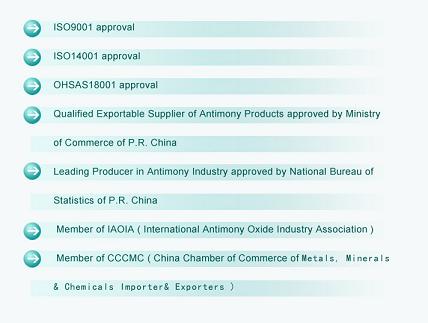
As manufacturer specialized in manufacturing of Antimony trioxide and Non-Halogen Flame Retardant,Since 2000, JIEFU have pioneered the manufacturing of flame retardant masterbatches in China.JIEFU initiated from custom flame retardant compounding of all commodity and engineering plastics to technologically sound production of fiame retardant masterbatches under the brand name JIEFU masterbatches.

Friday, April 25, 2008

China antimony market: Weekly comment--May Day holiday

After several weeks of slack in trade, China local antimony market is returning to a balance due to rising demand and supply shortage in antimony ore.

Recently small-scale antimony plants in Hunan Province have stopped operation. As a result, a decrease in production has led to a certain stabilization of antimony prices.

Besides antimony producers began to build inventories before May Day holiday.

However, despite the firmer demand, traders made few deals this week as most of antimony ingot manufacturers are waiting for higher prices.

In the previous week, tax-inclusive price of the No2 antimony ingot on Chinese domestic market was RMB41,500 per metric ton. Antimony trioxide was quoted at RMB37,000-37,500 per metric ton.

...
Read more...

Tuesday, April 15, 2008

European antimony market keeps increasing

Due to the port and river congestion in Vietnam, antimony metal is piled in China and cannot be ship to overseas. European participants reported to Asian Metal that prices are already around USD6,000/t in warehouse Rotterdam, and market will firm in the coming weeks.

A European trader sold several batches of antimony ingot in the passed week in the range of USD5,900-6,000/t in warehouse Rotterdam, and he claimed that he bought material from Chinese suppliers at around USD5,800/t CIF Rotterdam.

According to him, the consumers are interested in buying now that they are afraid that price may go up further in the near future because the material is not being shipped from Vietnam.

He also sells antimony to U.S., and disclosed that he concluded a few deals last week in the range of USD5,900-6,000/t in warehouse Baltimore. He is offering at above USD6,000/t for 99.65%min standard grade two antimony ingot at the moment.

A European trader confirmed increasing price of antimony at either sides of USD6,000/t in warehouse Rotterdam, and he had received some high offers from China. "One supplier made me a fresh offer today at USD6,300/t CIF Rotterdam for good grade of antimony ingot, but this is crazy price that no one is willing to buy at the moment," said the source.

According to him, he had received some low offers at the beginning of the week. "There was one offer of 60t at USD5,650/t CIF Rotterdam for standard grade two material, I took the offer with no hesitation." He thinks the price will continue to increase in the next few weeks with little material available at the

Although no deals concluded last week, the source was confident that more business would come this week. "Consumers buy when they see increasing prices," the source commented

A third trader disclosed that the offers from China are at around USD5,850/t CIF Rotterdam for 99.65%min standard grade two antimony ingot, and in the range of USD5,850-6,050/t in warehouse Rotterdam. He bought some material for his customer at the above prices for shipment arriving early May.

...
Read more...

American antimony trioxide market keeps firm

As supply is tight, American antimony trioxide keeps firm, and dealers reported deals concluded at USD2.65-2.70/lb d.d.p
A trader source disclosed to Asian Metal that he had sold several batches of antimony trioxide in the last two weeks, and deals were concluded in the range of USD2.65-2.70/lb for Twinkling Star brand 99.5%min antimony trioxide.
He opines that the supply from China is not as much as last year, and the consumers are looking for material that they have used up their inventories in the passed two months. "There was almost no new material arrived U.S. in February and March but the consumers continued their production, so the stockpile of the material is low." He holds high price of antimony trioxide is likely to remain for another few weeks.
A U.S. trader confirmed the higher prices of antimony trioxide in American market at USD2.65-2.70/lb d.d.p., and he holds that there is very little material in American warehouses. "Some people may still have a little material bought at cheap prices, but they want to hold for a little higher prices."
The source reviewed the antimony trioxide market from beginning of the year: "the price was very low at the beginning of this year, and many consumers purchased material at that time. Then we had the big jump of price during the Chinese New Year because less material shipped to America. Just about the price starting to fall at the end of last week, Chinese suppliers increased prices again.

...
Read more...

Friday, March 28, 2008

Easter holiday keeps European antimony market stable

With many people still not back to office now, European antimony market kept quiet so far this week. Market participants expect price to remain stable at the current level.

A European trader disclosed that Chinese suppliers are offering material at USD5,800-5,850/t CIF Rotterdam for 99.65%min low bismuth antimony ingot, but the major consumers in Europe are asking for lower price at USD5,700-5,750/t. "It is impossible for us to do business at the moment," said the trader.

He holds that price will keep stable this week due to the Easter holiday, and drop by another USD50/t next week when all European people come back to work.

Another European trader confirmed the price of USD5,750-5,850/t CIF and in warehouse Rotterdam for 99.65%min standard grade two antimony ingot, and he said Chinese suppliers stopped offering because the of the Western holiday. Therefore, there is no change in the market this week.

Commenting on the future market, the trader believes antimony metal price willn' t drop to below USD5,700/t,  and stabilize at that level until summer holidays.

...
Read more...

Premier Wen: Market to further determine RMB exchange rate

The Chinese government would further allow the market to determine the RMB exchange rate and more flexibility to the RMB band, Chinese Premier Wen Jiabao said Wednesday.

Wen made the remarks during a speech at the fourth EU-China Business Summit held here, which attracted about 500 entrepreneurs from China and the European Union (EU).

However, the premier also emphasized China would improve the RMB exchange rate regime "in a proactive, manageable and gradual manner," with a view to gradually enabling capital account convertibility.

Some Western countries have been pressuring China to revalue its currency RMB at a faster pace, complaining the exchange rate is the cause of global economic imbalance and mounting trade deficits they suffer from.

The Chinese premier obviously has a different view on the issue. "Exchange rate is a cause, but not the sole decisive factor, for trade deficits," he said.

"Since the RMB appreciated, China has seen no dwindling exports, which is a testimony to the existing global industrial structure and the competitive advantages enjoyed by Chinese products," he added.

Wen said the RMB exchange rate against the euro is determined by the RMB to U.S. dollar rate and the U.S. dollar to euro rate in the international market, adding the recent plunge of U.S. dollar was the main cause of an appreciating euro.

The premier also emphasized the importance of "moderate" revaluation of the yuan.

"The moderate tunings of the RMB exchange rate have been a source of stability for the Chinese economy and businesses, as well as its neighboring economies," he said.

China discontinued the yuan's peg from the U.S. dollar on July 21, 2005. Over the past two years, the RMB has appreciated 11.9 percent against the U.S. dollar and 7.4 percent against the Japanese Yen.

The yuan's central parity rate was 7.3899 against one U.S. dollar and 10.9614 against one euro on Wednesday.

The Chinese government has proactively and steadily advanced reform into the RMB exchange rate regime. It widened the yuan's daily trading band against U.S. dollar from plus or minus 0.3 percent to 0.5 percent in May.
Read more.....

...
Read more...

Chinese yuan climbs to new high against USD,export business is difficile to work

China's Renminbi (RMB) climbed 101 basis points to break the 7.02 mark on Wednesday, with the central parity rate at 7.05 yuan against one U.S. dollar, according to the Chinese Foreign Exchange Trading System.

The yuan broke the 7.05 mark at 7.02 yuan against one U.S. dollar only last Thursday.

This was the 68th new high the yuan has hit since the beginning of this year, up more than four percent accumulatively.

The accumulative appreciation since July 21, 2005, when China discontinued yuan's peg to the greenback, has exceeded 8.3 percent.

...
Read more...

Thursday, March 27, 2008

RMB Exchange Rate Might Appreciate by 5% in 2007

The exchange rate of Renminbi, the Chinese currency, is expected to appreciate by some five percent to one U.S. dollar for 7.44 yuan, according to Xinhua Economic Analysis Report released Monday.  

The report projected that the pace of RMB appreciation would befaster in the first half of 2007 than in the second half.  

Xinhua Economic Analysis Reports are regular products by a teamof more than 80 economic analysts under Xinhua Economic Information Department. The latest issue of the reports reviewed the country's ten key indices in the economic and financial sectors and made projections on possible changes in the coming year.  

In 2006, the value of the RMB rose 3.28 percent against the dollar, with an accelerating trend from 0.66 percent in the first quarter to 1.15 percent in the fourth. The central parity price closed at one U.S. dollar for 7.8141 yuan, the lowest of the year.  

The report held that the short-term RMB exchange rate will be influenced by the fluctuation between the dollar and other currencies, but in the long run, it depends on the progress of China's exchange rate reforms. Stable appreciation in small steps is generally expected.  

Earlier in December, China's State Information Center predicteda three-four percent appreciation of the yuan in 2007, while the Bank of America and Deutsche Bank expected a rise of four-six percent and 4.5 percent, respectively.  

China's foreign exchange policy is in line with the pace of China's economic development and the daily floating band is enoughto allow sufficient appreciation of the RMB, according to Chinese economist Fan Gang.  

However, some economists argued that the appreciation of the RMB is a double-edged sword, as it will make Chinese exports more expensive and therefore reduce export volume. Some export-driven small and medium companies may not be able to survive and have to lay off employees.  

"If China were coerced into really large appreciations of the RMB, it could face the same deflationary fate as Japan in the 1980s and 1990s -- and all this without reducing its trade surplus," said Ronald McKinnon in an article published Wednesday by The Wall Street Journal.  

Zhou Xiaochuan, governor of the People's Bank of China, said that there was no timetable for a further widening of the daily floating band between the RMB and the U.S. dollar.  

China raised the value of yuan by two percent to 8.11 per U.S. dollar and started linking it to a basket of currencies on July 21of 2005, and allowed it to move 0.3 percent above or below the parity rate against the U.S. dollar.  

The continuing appreciation of the RMB, a slowing world economyand the end of some tax rebates will reduce China's export growth to 20 percent year on year in 2007, the report predicted.  

From January to November of 2006, China's exports increased 27.5 percent over the same period in 2005.  
Read more............

...
Read more...

************Honor*************

************Honor*************