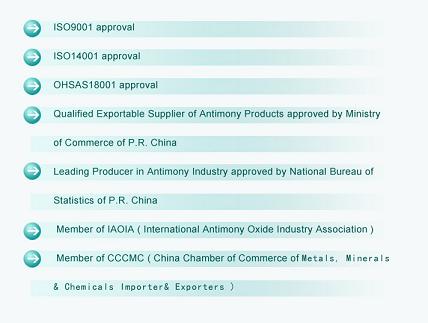
As manufacturer specialized in manufacturing of Antimony trioxide and Non-Halogen Flame Retardant,Since 2000, JIEFU have pioneered the manufacturing of flame retardant masterbatches in China.JIEFU initiated from custom flame retardant compounding of all commodity and engineering plastics to technologically sound production of fiame retardant masterbatches under the brand name JIEFU masterbatches.

Wednesday, April 15, 2009

China's Non-Ferrous Metals Stocks Face Limited Gains, UBS Says

BEIJING, Apr. 7 - China's non-ferrous metals producers have limited room for further share-price gains as they are trading close to their historical peak compared with the market and metals prices are forecast to decline, according to UBS AG.

Producers of non-ferrous metals, or those without iron, surged 84 percent from Jan. 5 to April 3 in Shanghai and Shenzhen trading, more than double the 29 percent advance by the Shanghai Composite Index, according to UBS. The London Metal Exchange Index of six metals, including copper, zinc and aluminum, climbed 13 percent in the same period.

The share-price gains have brought the relative valuations of the metals producers to 2.3 times the overall market, close to the historical peak of 2.49, the report said.

"The non-ferrous metals sector has become quite expensive compared to the market average, in the absence of commodity price support," Chen Li, Shanghai-based strategist at UBS, wrote in a note dated yesterday.

UBS has a "sell" recommendation on Aluminum Corp. of China Ltd., the nation's biggest producer of the metal.

"Non-ferrous metals' prices in the next few months will decline from the current level," indicating that the rally in the industry has "little support from fundamentals," the report said.

Investors should favor large Chinese lenders, such as Industrial & Commercial Bank of China Ltd. and China Construction Bank Corp., as their share prices reflect expectations for a narrowing of net interest margins and an increase in bad loans, the report said.

The brokerage has "buy" ratings on both ICBC and China Construction Bank, the nation's two largest banks.

...
Read more...

Chinese Zinc Imports Rise as Domestic Prices Outperform LME

BEIJING, Apr. 9 - Sources reported that the wide spread between Chinese refined zinc prices and those quoted on the London Metal Exchange (LME) has led to an increase in zinc imports over the past three months, as local importers make huge profits.

According to Beijing-based Galaxy Securities, zinc importers were earning an average RMB 500/mt to RMB 600/mt on imports in March, which has gone up to RMB 700/mt in April as Chinese domestic prices have outperformed the LME.

Chinese domestic zinc prices were at RMB 12,050/mt on Tuesday, much higher than LME three-month values at USD 1,350.5/mt on the same day.

According to the Chinese Customs, 89,703 mt of refined zinc was imported during the first two months of this year up by 633% YoY from the same period in 2008. According to Galaxy as well as other industry sources, China's zinc import volume in March is likely to be around 100,000 mt higher than the 77,205 mt imported in February.

Chinese custom figures for imports in the first quarter of this year were not yet available.

According to Hunan-based zinc producer Zhuzhou Smelter, supplies of locally produced zinc are very tight, following the State Reserve Bureau's (SRB) recent zinc purchases. A source at Zhuzhou said "Although we can still offer some zinc for domestic sales, stocks in the market are very limited."

A zinc trader with Guangdong based Maike Metal International Group said "Supplies from major zinc brands are limited and we are not sure when supplies will increase."

According to Galaxy, at the moment only privately owned smelters have some zinc stocks as the state owned smelters have sold a lot of their zinc to SRB earlier this year. So far this year, SRB has bought 159,000 mt of zinc from Chinese smelters. In January, SRB bought 59,000 mt of zinc at RMB 11,800/mt while in February it bought 100,000 mt at RMB 11,450/mt to RMB 11,500/mt.

Industry participants, however, expect zinc imports to slow down by mid-May, when the buying season ends. Zinc end-users in China, such as zinc alloy producers, usually buy materials between February and May every year once they are back from the Lunar New Year break end January.

...
Read more...

China's H2 Lead Demand Could Spurt on Higher Car Sales

BEIJING, Apr. 9 - Higher vehicle sales may drive up second-half demand for lead in China, the world's top lead and automobile market, sources at smelter and battery makers said on Wednesday.

Local media have said China's vehicle sales could post a monthly record for March after 2008 saw the lowest annual growth in more than a decade.

The rise may boost demand for lead from June or July, said Tang Chenghe, chairman of smelter Anyang Yubei Gold and Lead, which has 260,000 tonnes of primary and recycled lead capacity.

"There will be a gap between the car sales and demand for lead. (The demand) would be more obvious in two to three months' time," Tang told Reuters.

Demand for spot lead has climbed in the past two weeks in Shanghai, even though prices PB-1-CCNMM have already risen more than 20 percent since the beginning of this year, traders said.

But the rise has still lagged the rise on the London Metal Exchange. Benchmark three-month LME lead prices MPB3 have soared 32 percent this year, to $1,315 per tonne on Wednesday.

"The rise in car sales would benefit related supplies for the sector," said a purchasing official at Fengfan Company, one of the country's leading battery makers.

The firm's battery sales had risen about 10 percent from the fourth quarter, when battery demand at home and overseas fell because of the global economic slowdown, but sales are now at around the same level as a year ago.

The firm, which uses 100,000 tonnes of lead annually, had no plan to boost lead stocks yet, given that car makers were selling stocks, the official added. It holds stocks of about 2,700 tonnes of lead, or roughly 10 days' consumption.

Battery makers were not keen to build stocks at above 12,000 yuan ($1,754) per tonne, now at 12,750 yuan, as exports of battery remained weak, limiting the price rise, a Shanghai lead trader said.

"Everybody is talking about recovering car sales," the trader added. "What we saw is that the sales of lead have risen and prices are steady."Customs data showed China's exports of batteries for engines fell nearly 30 percent on the year to 1.844 million units in the first two months of this year, while those of batteries for other sectors dropped 36 percent to 13.312 million units.

But an official at Yuguang Gold and Lead 600531.SZ, China's top lead producer, said the country's large base of vehicles was supporting demand for lead.

"Just for the replacement of batteries for existing volumes, it is already big," the official said.

By the end of last year, China had 170 million vehicles and 80 million electric bicycles.

A battery for a passenger car uses about 9 kg of lead, while that for a truck requires 12 kilos. Electric bike batteries use about 7.5 kg of lead.

China's consumption of lead may rise 4 percent on the year to 2.86 million tonnes this year, state-owned research group Antaike predicts. Growth will be lower than last year, when consumption swelled by more than 10 percent.

...
Read more...

Thursday, April 2, 2009

China to Raise Tax Rebates on Textile, Metal Exports

BEIJING, Mar. 26 - China will raise the tax rebate rate on some textile, iron and steel, nonferrous metal, petrochemical, electronic information and light industrial exports starting April 1.

The decision was made at an executive meeting of the State Council, the country's Cabinet, Wednesday.

Participants to the meeting agreed that it was necessary to raise tax rebates on some export products, so as to fully implement the country's economic stimulus package and the support plans for ten industries, details of which were released in the past two months.

Exact amounts of the rebate had not yet been revealed by the State Council.

China raised the export tax rebate rate for textiles four times since last August. The previous increase in February went from 14 to 15 percent.

China's exports plummeted 25.7 percent year-on-year in February, the worst decline in more than a decade, as global demand deteriorated amid the deepening recession.

...
Read more...

China's '09 Cobalt Demand to Rise 3-4%

BEIJING, Mar. 27 - China's consumption of cobalt is expected to rise at least 3-4 percent this year because of strong demand from cellphone batteries, even though demand from other sectors may fall in the face of the global economic slowdown, an official at a refiner said on Wednesday.

But output may fall this year as low prices are discouraging producers from running full rates, which could cut exports from China, the world's top producer and consumer of cobalt.

China consumed 5.3 percent more cobalt at 13,519 tonnes last year, nearly a quarter of world demand, said Yang Zhai, marketing manager at Zhejiang Huayou Cobalt Co Ltd.

"Consumption should rise by more than 3-4 percent as demand from cellphones increases, particularly with the development of the 3G," Zhai told Reuters at the sidelines of a minor metals conference in Hong Kong.

Production of lithium cobalt oxide, which is used in batteries for cellphones, would rise by more than 5 percent this year from 5,478 tonnes last year, he predicted. That demand had taken up nearly half of China's cobalt consumption.

To develop China's new third generation (3G) mobile networks, the government has estimated that the country's three telecom carriers would spend $58.5 billion over the next three years.

With the expansion in 3G networks, ZTE Corp (0763.HK)(000063.SZ), the world's sixth largest cellphone maker, aims to raise revenue by a double-digit percentage this year.

Zhai said cobalt demand from the production of a catalyst, which was used in an oil product called purified terephthalic acid (PTA), would rise as oil prices stablised.

Demand from the sector, which accounted for 6 percent of the country's total consumption of cobalt, fell 29 percent to 950 tonnes last year due to sharp falls in oil prices.

FALLING OUTPUT

But production of cobalt may fall this year from 20,000 tonnes last year, a third of the world's output, as producers have slowed or shut production on weak prices of the metal, Zhai said.

He estimated about 6,000 tonnes of cobalt stocks had been carried to this year.

Spot refined cobalt with purity more than 99.6 percent traded at about 305,000 yuan per tonne in Shanghai on Wednesday, down 63 percent from a year earlier but up 9 percent this year.

Spot cobalt cathode COB-CATH-LON in London is trading around $16 per pound, down from more than $46 in the first half of last year.

China would continue to rely on imported material as feed for the production of refined cathode as local mines produced about only 1,000 of metal this year, he said.

...
Read more...

Monday, March 23, 2009

Antimony Trioxide Twinkling Star

As manufacturer specialized in manufacturing of Antimony trioxide and flame retardant masterbatch, our company has the best quality products and most competitive price.continuously supply our products to America,Europe,Nippon,Korea and so on,Consistent high quality, Prompt delivery, Low cost.Welcome long-term agencies oversea.

Meanwhile, we also deal with the Twinkling Star brand Sb2O3 and regularly store it into Baltimore warehouse.

Sb2O3 is well used as flame retardant in PVC industry. I'd like to seek any further opportunity with your company.

If interested, please feel free to contact me for further communication.

...
Read more...

Supply antimony trioxide

Antimony Trioxide

Antimony trioxide, also known as antimony oxide or Sb2O3, is the most widely produced compound of elemental antimony. The nations that produce the most antimony trioxide are China, South Africa, Bolivia, Russia, Tajikistan, and Kyrgyzstan. Typical applications for antimony trioxide include flame retardant synergist for use in plastics, rubber, paints, paper, textiles, and electronics; polyethylene terephthalate polymerization catalyst; a clarifying agent for glass; an opacifier for porcelain and enamel; and a white pigment for paint. When used as a flame retardant, antimony trioxide is often used in combination with halogenated compounds. Antimony trioxide is used as a synergist to enhance the activity of the halogenated flame retardant. In the absence of antimony trioxide about twice as much halogenated compound would be needed to reach the same level of flame retardancy.

Three grades of antimony trioxide

Jiefu is proud to offer three grades of antimony trioxide.

JIEFU KR grade antimony trioxide is suitable for almost all standard flame retardant and additive applications.

JIEFU Select is a higher purity grade of antimony trioxide compared to JIEFU KR. JIEFU Select can be used in flame retardant applications where lead levels are of concern, like in Europe to meet the requirements of the RoHS Directive. The Select grade is also used as a catalyst in PET production.

JIEFU's highest purity antimony trioxide product is JIEFU SP. JIEFU SP is suitable for highly lead and/or arsenic sensitive applications.

Product information

JIEFU KR, JIEFU Select, and JIEFU SP grades of antimony oxide are white, odorless, crystalline powders.

JIEFU offers flexible packaging options for all grades of our antimony trioxide. Standard packaging is available in 50 lb or 25 kg bags and in 2,000 lb or 1,000 kg supersacks. JIEFU can provide custom packaging upon request.

JIEFU brand antimony trioxide can be dampened with a variety of media including, but not limited to, ethylene glycol, diisodecyl phthalate (DIDP), and mineral oil.

...
Read more...

************Honor*************

************Honor*************